
Card Spotlight
Rust Syndicate Grunt: The Unexpected Comeback Mechanic
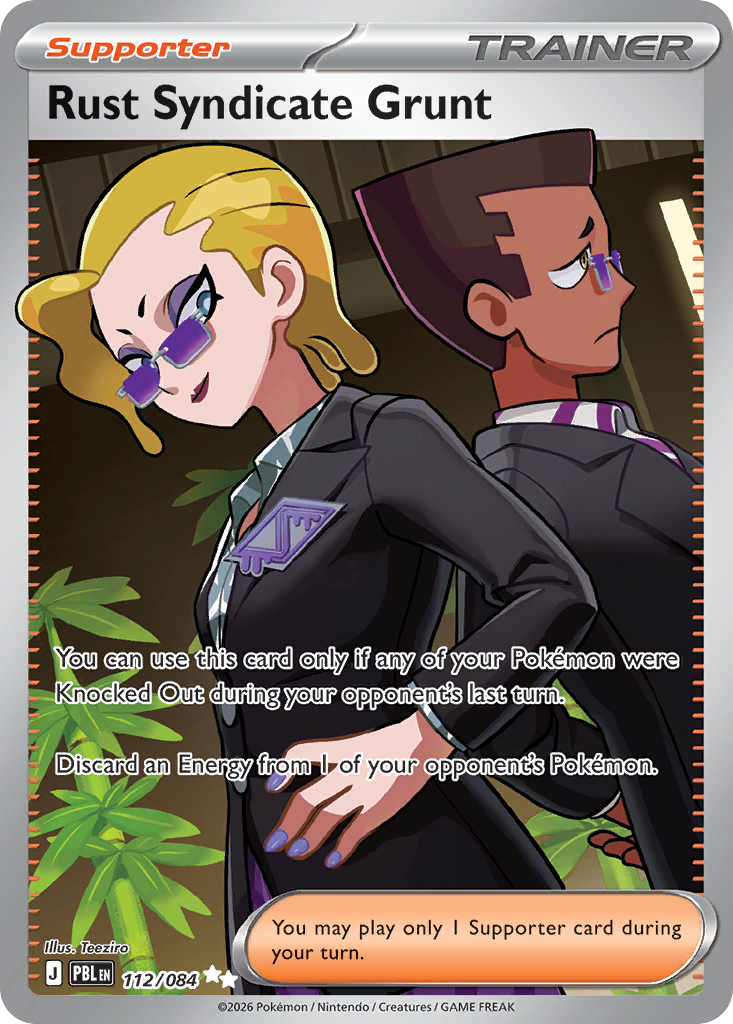
Rust Syndicate Grunt from Pitch Black is a new Supporter card offering a unique comeback mechanic by discarding Energy from your opponent's Pokémon. Learn what makes this card a potential game-changer, which decks can best leverage its disruptive power, and how to navigate its play condition.
Rust Syndicate Grunt: The Unexpected Comeback Mechanic
In the ever-evolving landscape of the Pokémon TCG Standard format, new cards constantly shift the meta. One card from the recent Pitch Black set, Rust Syndicate Grunt, is quickly gaining traction as a potential game-changer. This Ultra Rare Supporter card, with its unique activation condition and powerful disruptive effect, demands a closer look. Let's break down what makes this card so impactful, which decks will want to include it, how to play around it, and its current market standing.
What Does Rust Syndicate Grunt Do?
Rust Syndicate Grunt has a very specific, yet incredibly potent, effect:
- "You can use this card only if any of your Pokémon were Knocked Out during your opponent's last turn."
- "Discard an Energy from 1 of your opponent's Pokémon."
This Supporter card turns a disadvantage – having a Pokémon Knocked Out – into an opportunity for disruption. While its activation condition means it cannot be played proactively, its reactive nature allows for significant tempo swings, especially when facing decks that rely heavily on Energy attachments for powerful attacks.
Decks That Want Rust Syndicate Grunt
Rust Syndicate Grunt fits best into decks that can afford to trade KOs, especially those that benefit from slowing down their opponent's Energy acceleration or setup. Here are a few archetypes that could strongly consider this card:
1. Single-Prize Attacker Decks
Decks that primarily use single-Prize attackers are often designed to trade KOs efficiently. When a single-Prize Pokémon is Knocked Out, the opponent only takes one Prize card, but it enables Rust Syndicate Grunt. This allows the single-Prize deck to potentially slow down a two- or three-Prize attacker by discarding a crucial Energy, buying them time to set up another attacker or apply pressure.
2. Stall/Control Decks
Stall and control strategies thrive on disrupting the opponent's board state. While these decks typically try to avoid KOs themselves, when a Pokémon inevitably falls, Rust Syndicate Grunt provides an excellent counter-play. Discarding Energy can directly impede an opponent's ability to attack, fueling the stall strategy by extending the game. It can be particularly annoying against Mega Evolution Pokémon ex like Mega Chandelure ex or Mega Zeraora ex, which often require multiple Energy to power their devastating attacks, Phantom Maze and Thunderous Fist, respectively.
3. Any Deck Facing High-Energy Attackers
Even aggressive decks might find a place for Rust Syndicate Grunt as a one-of or two-of tech card. If the current meta is dominated by Pokémon that require 3-4+ Energy for their main attacks, such as the aforementioned Mega Evolution Pokémon ex or even powerful Stage 2 Pokémon like Rampardos ex (whose Rowdy Hammer attack benefits from its own Energy attachments), having a way to remove Energy can be invaluable. It can disrupt the opponent's attack sequence, forcing them to re-attach Energy and effectively losing a turn of offensive pressure.
The key for any deck considering Rust Syndicate Grunt is consistency. Since you can only use it after a KO, you need to ensure you can find it when that condition is met. Decks with strong draw support or search capabilities will naturally get more mileage out of it.
How to Play Around Rust Syndicate Grunt
Knowing your opponent might be running Rust Syndicate Grunt can influence your plays significantly. Here are some strategies to mitigate its impact:
1. Distribute Energy Wisely
Avoid stacking all your Energy on a single attacking Pokémon if possible. If you have multiple attackers on the Bench, consider distributing Energy across them. This way, if Rust Syndicate Grunt discards an Energy from your Active Pokémon, you might still have another attacker ready to go or a Benched Pokémon that only needs one more attachment to be a threat.
2. Prioritize Energy Acceleration
Decks that can quickly attach multiple Energy per turn (via abilities or other Supporter cards) are less affected by Rust Syndicate Grunt. If you can recover a discarded Energy within the same turn or on your next turn without sacrificing an attack, the disruption is minimal.
3. Attack with Low Energy Requirements
If your deck features attackers with low Energy costs, Rust Syndicate Grunt loses some of its bite. Attacking with a 1- or 2-Energy cost Pokémon means that even if an Energy is discarded, it's easier to re-attach and continue the attack. This is particularly relevant if your primary attacker can still hit for respectable damage with fewer Energy, or if you have a secondary attacker with a lower energy curve.
4. Utilize "Basic" Energy Retrieval
Cards that allow you to retrieve Basic Energy from the discard pile (e.g., Super Rod, Energy Recycler, or specific Pokémon abilities) can help mitigate the long-term impact of Energy discard. Having these options ready can turn a seemingly devastating Grunt play into a minor inconvenience.
5. Knock Out Non-Prize-Giving Pokémon First
While not always possible, if your opponent's deck has utility Pokémon that don't give up Prize cards (like certain Radiant Pokémon, although those are less prevalent in the current meta, or future cards with similar rules), Knocking them Out might deny your opponent the activation condition for Rust Syndicate Grunt if they don't have other Prize-giving Pokémon getting KO'd.
6. Consider Bench Protection
Sometimes, the threat of being Knocked Out on your turn to enable a Grunt on your opponent's turn isn't worth it. While you can't prevent your Active Pokémon from being KO'd if it's hit hard enough, being mindful of damage counters on your Benched Pokémon can help. For instance, if you're running a disruptive tool like Tremendous Bomb on a non-Mega Evolution Pokémon ex, you want that Pokémon to stay Active to deter large hits. If a Benched Pokémon with few HP is threatened, perhaps moving it to the Active Spot, knowing it will be KO'd and enable Grunt, might be a tactical choice to then disrupt your opponent.
Market Pricing and Rarity Notes
As an Ultra Rare from the recent Pitch Black set, Rust Syndicate Grunt (ME5-112) is currently finding its footing in the secondary market. At the time of writing (2026-08-03), its market price is "n/a" as the set is extremely new and pricing is still volatile. However, given its unique effect and potential to disrupt popular strategies, it's reasonable to expect its price to stabilize based on its playability. As more players experiment and top tournament results emerge, expect its value to become clearer. Ultra Rares typically hold a moderate to high value depending on competitive demand, and Rust Syndicate Grunt has all the hallmarks of a competitively relevant card.
Conclusion
Rust Syndicate Grunt is a fascinating addition to the Standard format. It cleverly turns a setback into a strategic advantage, offering disruptive power to decks that can embrace its reactive nature. Whether you're piloting a single-Prize focused deck, a control archetype, or simply need an answer to Energy-hungry threats, this Ultra Rare Supporter from Pitch Black is worth serious consideration. Understanding its conditions and implications, both for playing it and playing against it, will be crucial for navigating the evolving meta in the coming months.